
You cannot put a Fire out—
A Thing that can ignite
Can go, itself, without a Fan—
Upon the slowest Night—
You cannot fold a Flood—
And put it in a Drawer—
Because the Winds would find it out—
And tell your Cedar Floor—
— Emily Dickinson
With this poem, Jake Bittle begins his book, The Great Displacement: Climate Change and the Next American Migration, which lays out, community by community across our country, the human efforts and costs of trying to push back nature in the face of climate change.
Chosen to foster a community-wide discussion focused on the environment, the 2024-2026 two-year thematic focus of our Honors Unbound program, all 3,500 Honors College students were asked to both read and examine its case studies and overarching message.
The monograph has also been incorporated into honors coursework, as well as co-curricular, extra-curricular, and social programming throughout this academic year, as forums for exploring its interdisciplinary explanations of the physical and social impacts of climate change.
Mr. Bittle, a staff writer for Grist, published the book in 2023 (Simon & Schuster). He wrote, “For a long time, climate change was something to be discussed in abstract terms, something that existed in the future tense. That is no longer the case. Each passing year brings disasters that disfigure new parts of the United States, and these disasters alter the course of human lives, pushing people from one place to another, destroying old communities and forcing new ones to emerge.”
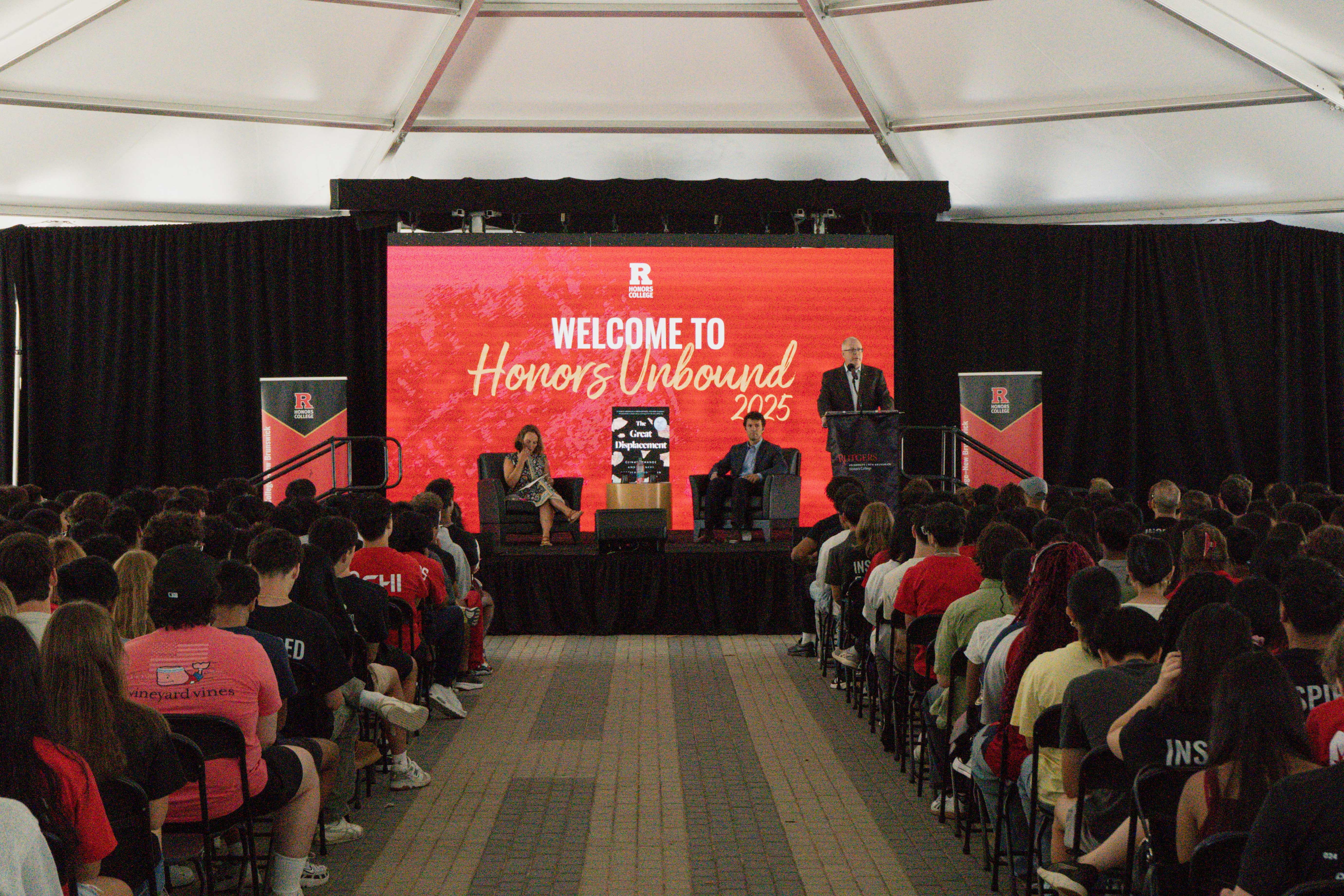
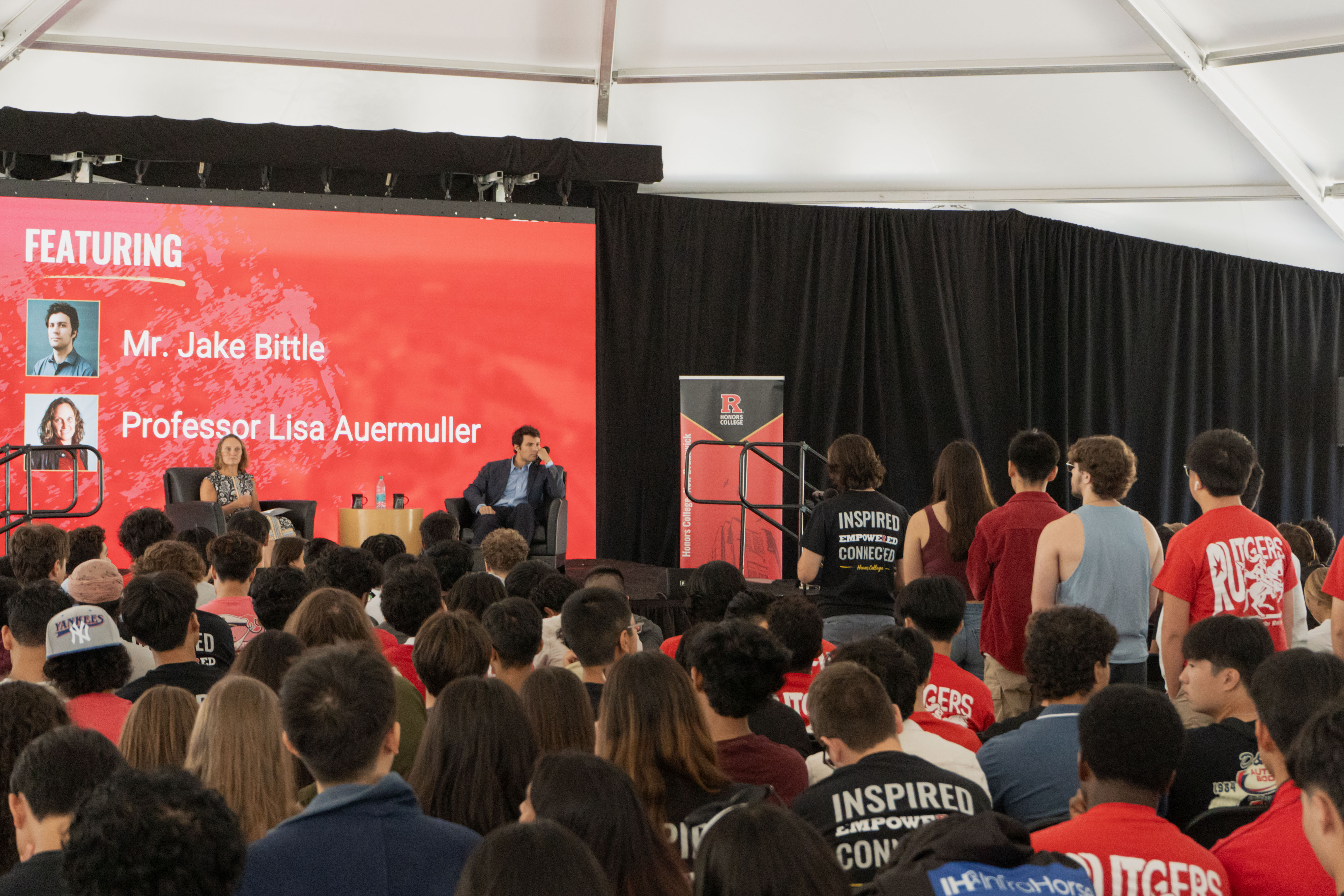
On August 27, during the Honors College Welcome Week, more than 800 first-year Honors College students gathered to hear Mr. Bittle talk about his book with Mrs. Lisa Auermuller, an associate director with the Rutgers Department of Marine and Coastal Sciences, located at the Rutgers University Marine Field Station in Tuckerton, NJ, who researches and translates the impacts of climate change in coastal New Jersey.
During their conversation, Mr. Bittle shared that he grew up near Tampa, Florida, a place not directly impacted by a hurricane for 90 years, but last year, he found himself returning there to cover back-to-back hurricanes and talking with people he knew who were impacted. He noted that five years ago, there was minimal public discussion about climate migration here in the United States, but that has changed.
“I didn’t feel qualified to write about it, but as I was learning more about government policy and insurance and the emphasis on money, I saw how we fall short on restoration and that people are so often still scarred and communities less vibrant,” said Mr. Bittle. “I thought it would be more effective to write about people—more relatable. I wanted to memorialize that…centuries of history and culture are being lost in places. Disasters could be opportunities for change, but we don’t do that.”
Informed by her own research along the New Jersey coast, Mrs. Auermuller asked Mr. Bittle where it is safe to build affordably, a question he used to get asked often, making the point that we, as people, can struggle with what we know in our heads and what we feel in our hearts—that we can be tied to a place regardless of the risk. He noted that coastal geographies are uneven and that even small areas can have wildly different risk. “People don’t go around thinking about risk statistics—it’s not a pleasant way to live. They know they should move, but it’s a hassle and expensive. But people and communities need to understand their risk and make a plan. When you prepare, you can reduce risk. You just need to think about it.”
During the Q&A, students followed up on that point asking how we can prevent people from building in risky places. Mr. Bittle responded, “Maybe through policy and buyout programs, and certainly there are affordability considerations that impact class demographics and what’s possible, but you can’t tell people to leave or stay. Communities can consider surrendering land to nature, but where possible, people won’t stop building on shorelines.”
The evening before while dining with students who were part of the book selection committee, staff, and the Dean of the Honors College, J.D. Bowers, Mr. Bittle shared his thoughts on talking with young people about climate change: “I wanted to make this book accessible to people in disparate places. The ideal reader is completely open-minded…someone not already in-the-know and without assumptions.”
“It’s hard to predict what’s going to happen—science is certain but the trajectory for how you fix things is unclear and chaotic,” he added. “There’s lots of room for innovation and changes in public policy, and there is active debate on so many levels. We just need more people with open minds and interdisciplinary thinking addressing it.”
David Gregory (’27, SOE/HC), one of the students who joined for dinner, said, “I wanted to get more involved with literature and to engage in our community around this book, which helped me understand climate change not only scientifically, but socially—as something that reshapes neighborhoods, families, and identities.” Sadhana Vasanthakumar (’28, SAS/HC), who also joined the dinner said, “As a computer science major, I love to step away and read, and this book is so human…not technical. It really resonated with me…a reality check that climate change is happening right now.” The Common Read book selection committee was advised by Honors College Faculty Fellows Talia Robbins and Trip McCrossin.
“The common reading has been a longstanding program within the honors community as one of the most high-impact approaches in learning and engagement,” said Dean Bowers. “By reading a deeply timely book that explores climate change in an interdisciplinary way and engaging with Jake during his visit, our students can begin to understand how they might contribute to solutions in whatever direction they are pursuing in their studies and future career—we all must contribute to lifting each other and communities through such challenges.”
When asked by Mrs. Auermuller what advice he would give to his 18-year-old self, Mr. Bittle said, “In the words of the great writer Robert Caro, ‘Turn every page.’ And, even if you think you know, ask your questions—there are no stupid questions.”
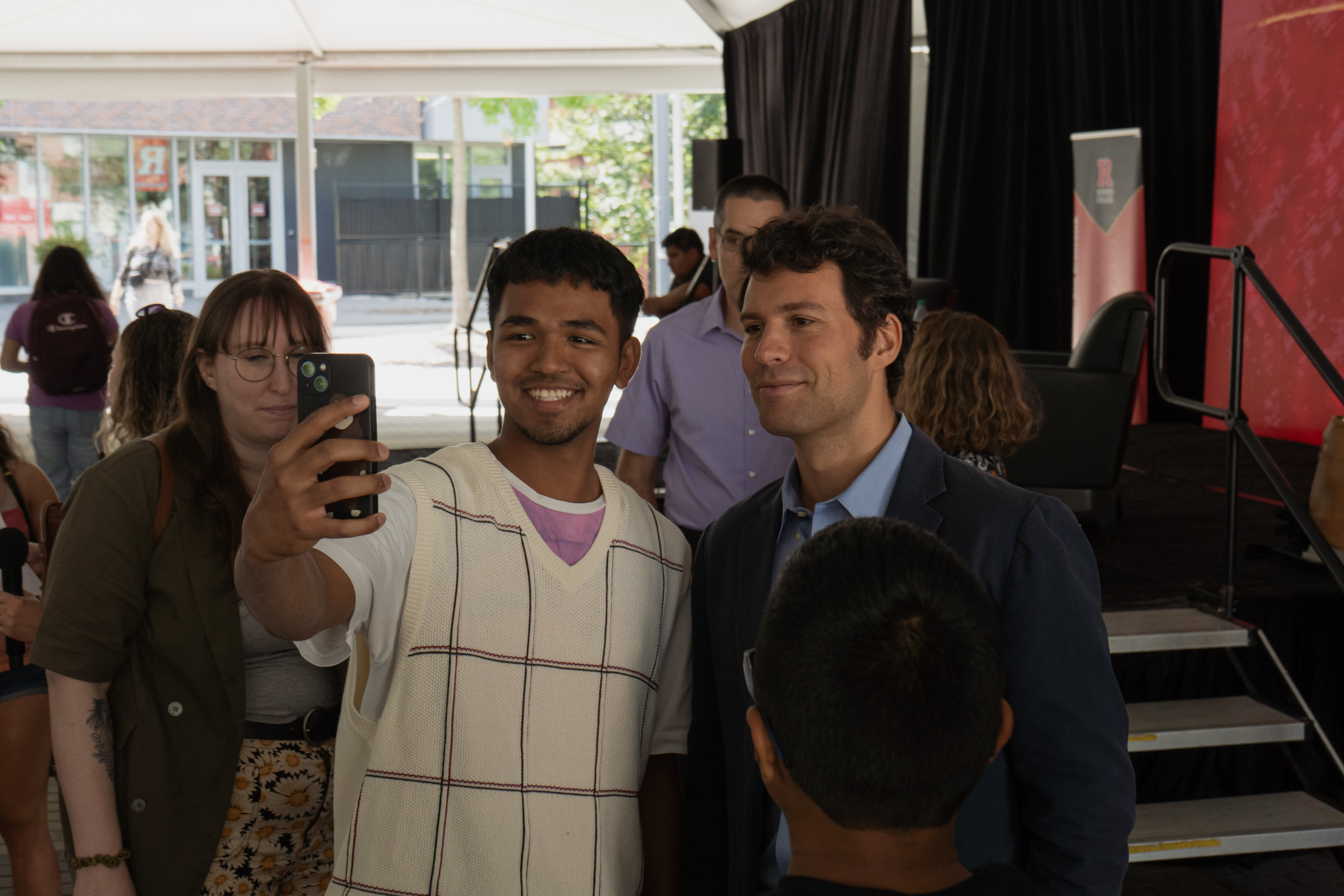
Mr. Bittle’s book and visit shaped our students’ awareness and understanding and gave them an extraordinary opportunity to engage with him. Reflecting on his visit, it also shaped Mr. Bittle’s own outlook on his work: “It really was such a privilege to participate and to have students engage so deeply with the book. I said this at the time, but it’s still true now—it really gave me hope!“